Journal of Water and Wastewater; Ab va Fazilab (in persian)

Journal of Water and Wastewater; Ab va Fazilab (in persian)

Journal of "Water and Wastewater" began its activities in 1989 with the aim of advancing knowledge and technology in the field of sustainable water and wastewater management, as well as providing innovative solutions to related challenges. Since 1996, the journal has obtained scientific-promotional accreditation from the Ministry of Science, Research, and Technology, and later, from 2005, it gained scientific-research accreditation, making it one of the most reputable scientific journals in the country.

Since 2014, this journal has been published bimonthly, with six issues a year in both Persian and English. The research areas covered by the journal include water supply and demand management, wastewater treatment, urban hydrology, and the application of modern technologies in the water and wastewater industry. With a rigorous peer-review process and open access to articles, the journal promotes related sciences and facilitates the exchange of research findings. Additionally, in 2024, based on the ranking by the Ministry of Science's Publication Evaluation Commission, it achieved an "A" ranking.


Access to the articles on this site is free.


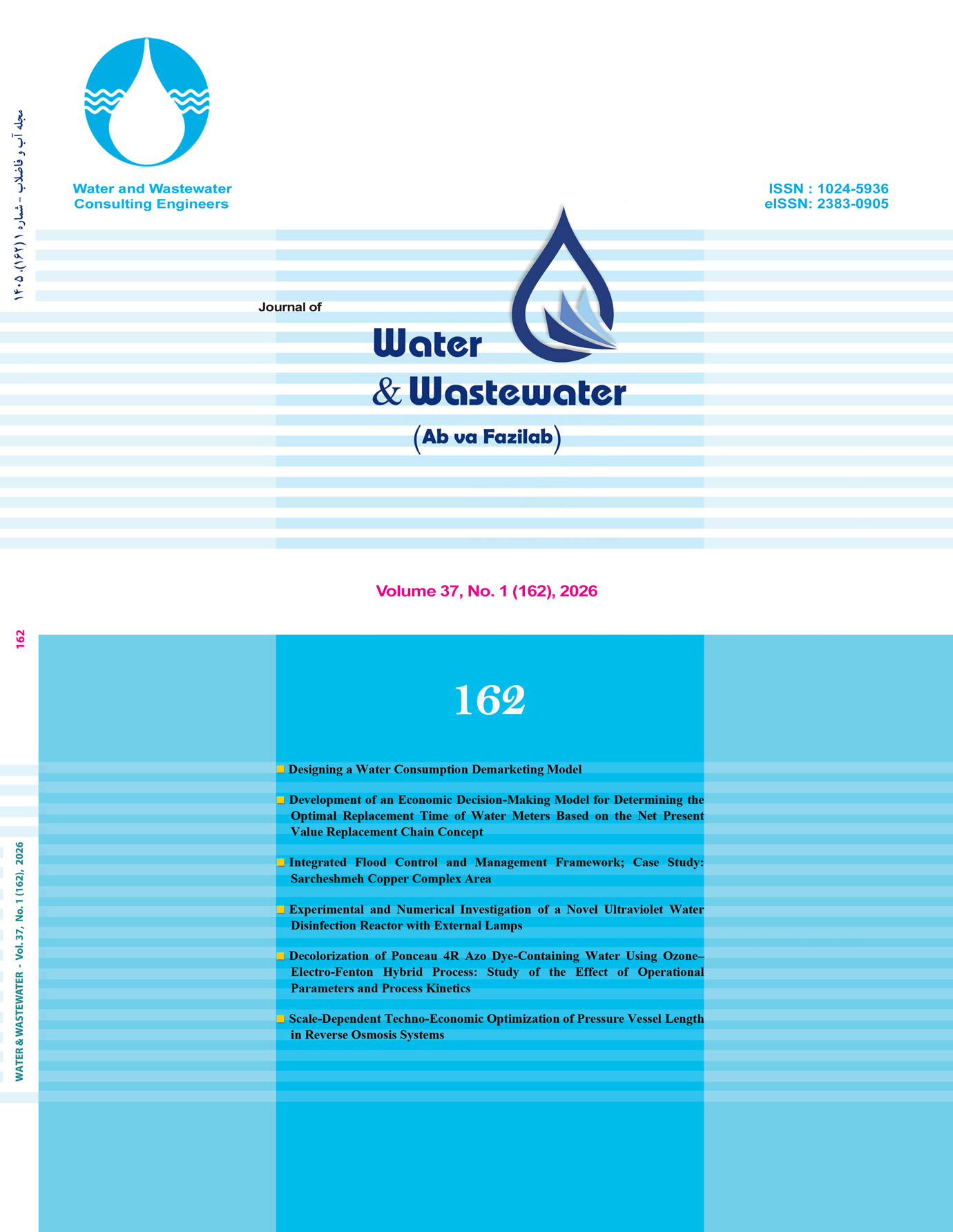
Current Issue: Volume 37, Issue 1 - Serial Number 162, March and April 2026, Pages 1-127 

Designing a Water Consumption Demarketing Model

Pages 1-17

10.22093/wwj.2026.588408.3561

Masoud Azar, Mohammad Reza Dalvi Esfahan, Zahra Dashtlaali

Integrated Flood Control and Management Framework; Case Study: Sarcheshmeh Copper Complex Area

Pages 41-63

10.22093/wwj.2026.594870.3570

Maryam Azarpira, Reza Esmaili, Maryam Moradi Moosavi, Rasoul Habibi, Alireza Badie Neshin, Hamed Rezaeipour Ghanat Nowji

Keywords Cloud

  • Adsorption
  • Wastewater Treatment
  • optimization
  • Wastewater
  • heavy metals
  • COD
  • Cadmium
  • Industrial Wastewater
  • Groundwater
  • Water Treatment
  • Water Distribution Network
  • Electrocoagulation
  • Lead
  • Nitrate
  • Drinking Water
  • Phenol
  • Turbidity
  • Activated sludge
  • photocatalyst
  • Simulation
  • Isotherm
  • Genetic algorithm
  • Removal
  • Desalination
  • Aqueous solution
  • graphene oxide
  • Activated carbon
  • Heavy metal
  • Biosorption
  • Chitosan
  • Hydrogen peroxide
  • Phytoremediation
  • ARSENIC
  • Water Pollution
  • Artificial Neural Network
  • Membrane
  • Water Quality
  • Modeling
  • GIS
  • leachate
  • Wastewater Treatment Plant
  • Water
  • Uncertainty
  • Biofilm
  • Conjunctive use
  • water distribution networks
  • Ozonation
  • Aqueous solutions
  • Adsorption Isotherm
  • Chromium
  • Nanofiltration
  • Advanced oxidation
  • sewage sludge
  • Pollution
  • Disinfection
  • Methylene blue
  • Risk Assessment
  • Kinetic
  • Sensitivity analysis
  • pH
  • Effluent
  • nickel
  • Zeolite
  • Coagulation
  • Mercury
  • Municipal wastewater
  • Nanocomposite
  • Reliability
  • Biological Treatment
  • Biodegradation
  • Response Surface Methodology
  • COD removal
  • Chromium (VI)
  • water hammer
  • Antibiotic
  • Thermodynamic
  • Advanced Oxidation Process
  • TiO2
  • Sequencing Batch Reactor
  • water crisis
  • Sludge
  • Reuse
  • vulnerability
  • system dynamics
  • Nitrate removal
  • Caspian Sea
  • Calibration
  • Malachite Green
  • Reverse Osmosis
  • Nanoparticles
  • Leakage
  • treatment
  • Environmental pollution
  • Bioremediation
  • Taguchi method
  • EPANET
  • Central composite design
  • Kinetics
  • adaptive neuro-fuzzy inference system
  • Compost
  • Longitudinal Dispersion Coefficient
  • SBR
  • Algae
  • Artificial Neural Networks
  • Neural Network
  • Ultrafiltration
  • Membrane bioreactor
  • Bentonite
  • Surfactant
  • AHP
  • Conflict Resolution
  • Fuzzy logic
  • public-private partnership
  • Filtration
  • irrigation
  • Pressure Management
  • MTBE
  • Salinity
  • Electrospinning
  • Phosphate removal
  • Carbon Nanotube
  • Alum
  • Composite
  • Clustering
  • Depth-averaged velocity
  • Chemical Oxygen demand
  • Membrane Fouling
  • Surface water
  • Factor analysis
  • Experimental Design
  • PAHs
  • Dye removal
  • Particle Swarm Optimization
  • TOC
  • runoff
  • Removal Efficiency
  • Aluminum Electrode
  • Forecasting
  • Bacteria
  • Carbon nanotubes
  • Water Resources Management
  • Water resources
  • Nitrification
  • Polyaluminum Chloride
  • fish
  • Tetracycline
  • Analytical Hierarchy Process
  • ANFIS
  • Genetic Algorithm
  • Isfahan
  • Kinetic Models
  • Multi-Objective Optimization
  • Constructed Wetland
  • Sewage
  • Suspended Solids
  • Sedimentation
  • copper
  • Visible light
  • Water allocation
  • Temperature
  • Operation
  • Sawdust
  • Optimal Operation
  • Silver nanoparticles
  • Mixing
  • Langmuir isotherm
  • Coagulation and Flocculation
  • Electro-fenton
  • prediction
  • Contaminated Water
  • CE-QUAL-W2
  • Aerobic Granules
  • Integrated Water Resources Management
  • Yazd
  • Surface modification
  • SWMM
  • Adsorption kinetics
  • Bioassay
  • Kinetic Coefficients
  • Biomass
  • sustainable development
  • ANN
  • Backwash
  • Urban Runoff
  • Dye
  • Polyaniline
  • Eutrophication
  • Purification
  • Photocatalytic degradation
  • Waste Load Allocation
  • Standardized Precipitation Index (SPI)
  • hydraulic retention time
  • BOD5
  • Water Consumption
  • HEC-RAS
  • Unsteady flow
  • aniline
  • River Water Quality Management
  • Artificial intelligence
  • Water Distribution Systems

Related Journals