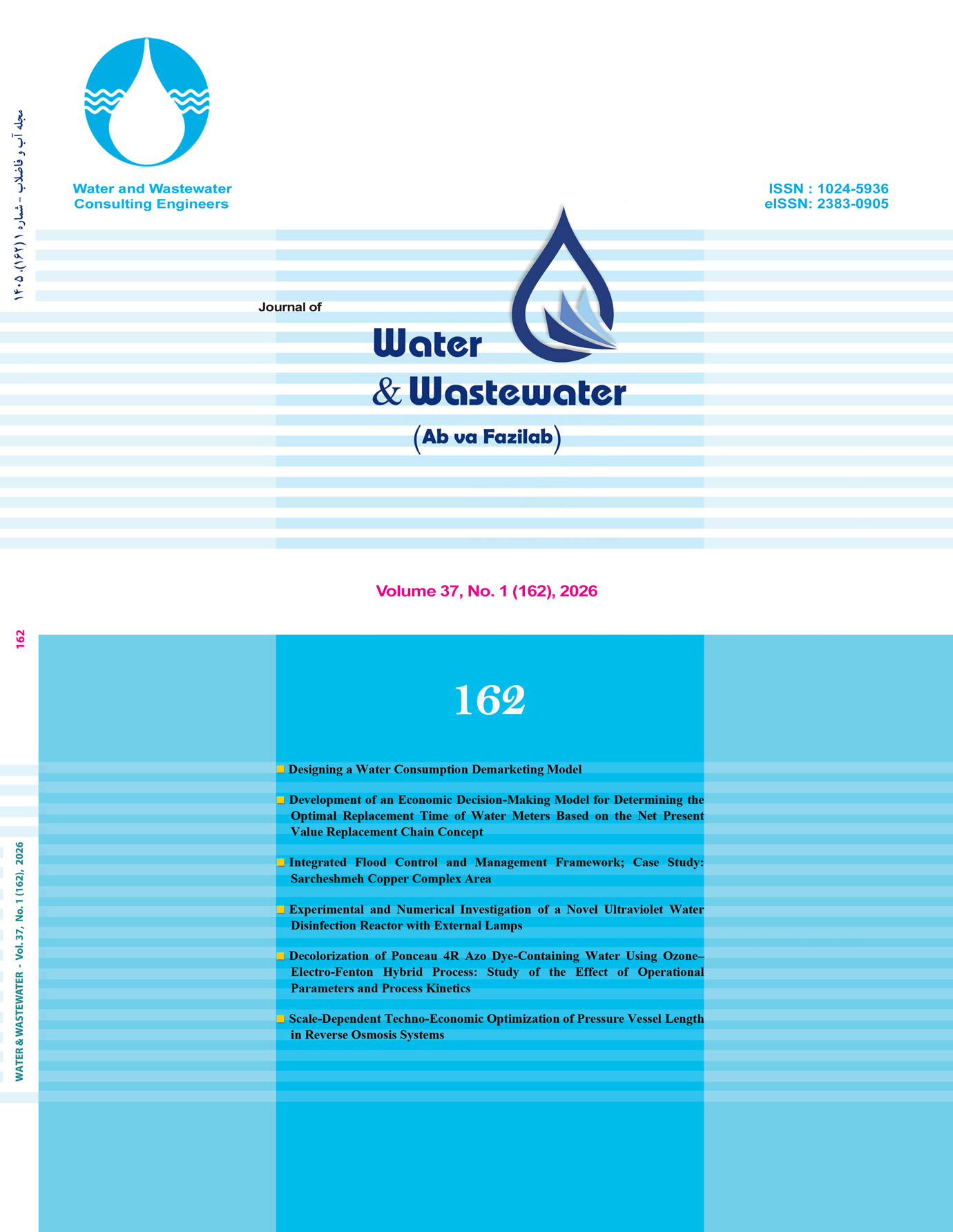
Journal of Water and Wastewater; Ab va Fazilab (in persian)

Journal of Water and Wastewater; Ab va Fazilab (in persian)

Journal of "Water and Wastewater" began its activities in 1989 with the aim of advancing knowledge and technology in the field of sustainable water and wastewater management, as well as providing innovative solutions to related challenges. Since 1996, the journal has obtained scientific-promotional accreditation from the Ministry of Science, Research, and Technology, and later, from 2005, it gained scientific-research accreditation, making it one of the most reputable scientific journals in the country.

Since 2014, this journal has been published bimonthly, with six issues a year in both Persian and English. The research areas covered by the journal include water supply and demand management, wastewater treatment, urban hydrology, and the application of modern technologies in the water and wastewater industry. With a rigorous peer-review process and open access to articles, the journal promotes related sciences and facilitates the exchange of research findings. Additionally, in 2024, based on the ranking by the Ministry of Science's Publication Evaluation Commission, it achieved an "A" ranking.


Access to the articles on this site is free.


Current Issue: Volume 37, Issue 1 - Serial Number 162, March and April 2026, Pages 1-127 

Designing a Water Consumption Demarketing Model

Pages 1-17

10.22093/wwj.2026.588408.3561

Masoud Azar, Mohammad Reza Dalvi Esfahan, Zahra Dashtlaali

Integrated Flood Control and Management Framework; Case Study: Sarcheshmeh Copper Complex Area

Pages 41-63

10.22093/wwj.2026.594870.3570

Maryam Azarpira, Reza Esmaili, Maryam Moradi Moosavi, Rasoul Habibi, Alireza Badie Neshin, Hamed Rezaeipour Ghanat Nowji

Keywords Cloud

  • Adsorption
  • Wastewater Treatment
  • optimization
  • Wastewater
  • heavy metals
  • COD
  • Cadmium
  • Industrial Wastewater
  • Water Distribution Network
  • Groundwater
  • Water Treatment
  • Electrocoagulation
  • Nitrate
  • Lead
  • Phenol
  • Drinking Water
  • Turbidity
  • Activated sludge
  • photocatalyst
  • Simulation
  • Genetic algorithm
  • Isotherm
  • Removal
  • Desalination
  • Aqueous solution
  • Heavy metal
  • Activated carbon
  • graphene oxide
  • Biosorption
  • Phytoremediation
  • Water Pollution
  • Hydrogen peroxide
  • Artificial Neural Network
  • Chitosan
  • ARSENIC
  • Modeling
  • Water Quality
  • Membrane
  • Water
  • GIS
  • leachate
  • Uncertainty
  • Biofilm
  • Wastewater Treatment Plant
  • water distribution networks
  • Ozonation
  • Conjunctive use
  • Aqueous solutions
  • Adsorption Isotherm
  • Nanofiltration
  • Chromium
  • Advanced oxidation
  • Pollution
  • nickel
  • Risk Assessment
  • Methylene blue
  • sewage sludge
  • pH
  • Sensitivity analysis
  • Effluent
  • Zeolite
  • Disinfection
  • Kinetic
  • Mercury
  • Coagulation
  • Municipal wastewater
  • Biodegradation
  • Biological Treatment
  • COD removal
  • Reliability
  • Response Surface Methodology
  • Nanocomposite
  • Chromium (VI)
  • Sludge
  • water hammer
  • Thermodynamic
  • TiO2
  • Sequencing Batch Reactor
  • Antibiotic
  • vulnerability
  • Advanced Oxidation Process
  • water crisis
  • Nitrate removal
  • system dynamics
  • Caspian Sea
  • Malachite Green
  • Calibration
  • Reverse Osmosis
  • treatment
  • Leakage
  • Nanoparticles
  • Reuse
  • Environmental pollution
  • EPANET
  • Taguchi method
  • Central composite design
  • Bioremediation
  • Kinetics
  • Longitudinal Dispersion Coefficient
  • adaptive neuro-fuzzy inference system
  • Artificial Neural Networks
  • Compost
  • Ultrafiltration
  • SBR
  • Algae
  • Neural Network
  • Bentonite
  • AHP
  • Surfactant
  • Membrane bioreactor
  • Conflict Resolution
  • Fuzzy logic
  • public-private partnership
  • irrigation
  • Filtration
  • Pressure Management
  • Salinity
  • MTBE
  • Surface water
  • Artificial intelligence
  • Phosphate removal
  • Electrospinning
  • Carbon Nanotube
  • Alum
  • Depth-averaged velocity
  • Experimental Design
  • Factor analysis
  • Chemical Oxygen demand
  • Composite
  • Silver nanoparticles
  • Membrane Fouling
  • Clustering
  • PAHs
  • Dye removal
  • runoff
  • Particle Swarm Optimization
  • Removal Efficiency
  • Aluminum Electrode
  • Bacteria
  • Integrated Water Resources Management
  • Carbon nanotubes
  • Nitrification
  • Water resources
  • Water Resources Management
  • Polyaluminum Chloride
  • Genetic Algorithm
  • Tetracycline
  • Analytical Hierarchy Process
  • TOC
  • ANFIS
  • Isfahan
  • Multi-Objective Optimization
  • Suspended Solids
  • Sedimentation
  • Constructed Wetland
  • Sewage
  • Temperature
  • Kinetic Models
  • Visible light
  • Sawdust
  • Water allocation
  • Optimal Operation
  • Operation
  • fish
  • copper
  • Electro-fenton
  • Mixing
  • Coagulation and Flocculation
  • Langmuir isotherm
  • Contaminated Water
  • CE-QUAL-W2
  • prediction
  • Yazd
  • Aerobic Granules
  • Surface modification
  • Forecasting
  • Bioassay
  • Adsorption kinetics
  • Backwash
  • sustainable development
  • Standardized Precipitation Index (SPI)
  • ANN
  • Biomass
  • hydraulic retention time
  • Kinetic Coefficients
  • Eutrophication
  • Polyaniline
  • Dye
  • Purification
  • Photocatalytic degradation
  • Waste Load Allocation
  • Urban Runoff
  • aniline
  • Unsteady flow
  • HEC-RAS
  • Water Consumption
  • Water Reuse
  • Color
  • Water Distribution Systems
  • River Water Quality Management

Related Journals